Powered By Blogger
Showing posts with label Australia. Show all posts

Saturday, 8 October 2011

Small Pet Birds - Australian Grass Parakeets

Yes I know it's took me a long time to get around to this as I promised it months ago.  I've been so busy it has had to take a back seat for a while and even now it is not much more than a previous post but with pictures and links added in, but at least you will be able to access more info about these beautiful little parrots.

Australian grass parakeets are popular as pets or aviary birds due to their colourful markings, small size and placid nature. About the same size as budgerigars; they do however command a premium price by comparison but are well within the reach of most enthusiasts. There are about 6 popular species of grass parakeet used in aviculture.

All the species of Australian grass parakeets are closely related to the budgerigar but unique in their own separate ways. When kept as domestic birds they have very similar requirements to budgerigars; same type and size of nest box, same or similar type of food etc. so their requirements are easily met.

Originating from the grasslands of their native land as the name suggests, these are beautiful little parrots in a good variety of colours; often the iridescence of their plumage makes them even more attractive to the bird keeper. Also their calm and placid nature is an added attraction along with the fact that they are not prone to annoying squawking and often emit nothing more than a just audible chirp, making them ideal in flats or apartments where a quiet pet is beneficial.
Grass parakeets are readily available on the market but due to their desirable characteristics and appearance you will find that demand often outstrips supply. So don’t expect to pay less than £30 each and often more; not a bad price really but quite steep when compared to their nearest pet neighbours, the budgerigars which can often be picked up for £10 or even less.

A bit more information about grass-parakeets (or grass parrots as they're also known) is available from 'grassparakeet.com', 'proaviculture.com', and 'avianweb.com'.
The most common species as pets are the bourke (bourke’s parakeet), scarlet-chested (splendid), turquoisine, elegant parakeet, rock parrot, blue-winged parakeet, and the red-rump. Search for any of these in a good online image search and you will notice immediately why they are so desirable to bird keepers.

 
Bourke
Neopsephotus Bourkii

It is claimed that of all the grass parakeets these are the easiest to keep in captivity, as they are very undemanding. They originate from central and south-western Australia and are approximately 7.5 inch 19 cm long. Bourke’s parakeets are considered by some to be rather dull due to their brown colour but they do have a pink front and blue on the wings, there are some brightly coloured mutations however such as the rosy bourke, and all have a calm and charming nature.

Click here for a related video.

More stuff on the bourke can be had by going here or alternatively click this link.


Elegant
Neophema elegans

Native to southern Australia the elegant grass parakeets are olive-yellow in colour with a blue band across the forehead and along the edge of the wings and are about 8.75 inch 22 cm long. Very popular as captive birds with many keepers throughout the globe.

The elegant grass parakeet on video

More information from 'AvianWeb' and 'Wikipedia'

  
Red rump
Psephotus haematonotus

Originating from southeast Australia and found in flocks or pairs in open country, also frequenting suburban gardens and parks but avoiding the wetter heavily timbered areas and coastal regions. A medium sized parrot of about 25 – 28 cm 9.75 – 11 inches and emerald green in colour with yellow underparts, the actual red-rump only applies to the male of the species.

Red rump on video at 'YouTube'

Red rump at a our old friends 'AvianWeb' and of course 'Wikipedia'


Blue-winged
Neophema chrysostoma

A migratory species that breeds in Tasmania but sees the winter out in southeast Australia, found in flocks of up to 2000 before migration but usually in pairs during the breeding season. These little parrots are about 20 – 22 cm 8 – 8.5 inches and mainly olive green with a blue band to the forehead and edge of wings and yellow belly (very similar markings to the elegant but the blue banding is less profound).

Here's a video with the blue-winged grass parakeet in it.

More stuff on the blue-winged can be sought from 'AvianWeb' or alternatively 'Wikipedia', or if you like try both.


Splendid
Neophema splendida

Also commonly known as the scarlet-chested parakeet and often confused with the turquoisine due to similar markings. About 7.5 to 8 inches 19 – 20 cm in length. As their name implies these have a scarlet chest but also a yellow belly and underside, bright blue (often iridescent) head and wing edges and a deep green back and rump. Considered by some to be the most beautiful of the grass parakeet species and so making them very popular in captivity. Native to western new south Wales and interior western Australia.

Watch splendid grass parakeet at 'YouTube'

More details by going here and here

 
TurquoisineNeophema pulchella

Once common throughout eastern Australia but now mainly found in the north eastern areas. Approximately 20 cm 8 inch long. Also a desirable and popular pet due to its calm and placid nature (a trait that seems common in all grass parakeets) and it’s wonderful iridescent turquoise colouring to the crown, face and edges of wings, green back, often orange-yellow chest and red belly.
A bit of a movie star is the turquoisine, here are not one but three vids for you:
Vid 1
Vid 2
Vid 3

Of course these entries wouldn't be the same without our 'Wikipedia' and 'AvianWeb' links.

View pictures related to this post on 'Facebook'

Hope this has satisfied your curiosity, more Aussie birds will be up here one day but I can't promise when, after all it took me long enough to get this one on here, so just watch this space.

Thursday, 25 August 2011

How to be sure your small pet birds can survive the harsh winter conditions that are soon to come

Autumn will be here sooner than we know it; after all we are already at the end of August.  What happened to summer?  Last winter was pretty harsh with heavy snowfall here in the UK, so there's a good chance that this winter may turn out the same.  Your tropical pet birds need to be suitably protected to withstand a harsh winter season.

Larger tropical pet birds are more likely to be able to cope with the freezing conditions but they still need some protection.  Small pet birds however will require good quality protection from the onslaught of winter, as their smaller size means that they will cool down much quicker than their bigger cousins.  Fortunately your small pet birds are quite hardy and are more than able to stand the cold than you might imagine as long as suitable requirements are met.  For example, in Australia where many tropical pet birds originate from the night time temperatures can become very cold in certain areas but the birds survive OK. 

For more information read my article about this matter at 'GoArticles'.

Have you noticed that when the weather is freezing cold you are usually quite comfortable if there is no wind and you are dry.  Tropical pet birds are the same; they don't mind getting wet, they don't mind cold wind or draughts, they don't mind freezing cold temperatures, but they are not going to take them all at once.  As long as your small pet birds have had a good feed and built up a nice layer of cold-protecting fat they are happy.  So make sure they've got a plentiful and continuous supply of food to help them feel comfortable.

Also don't allow small pet birds like finches to go without light for more than a maximum of eight hours.  An automatic switch that switches on and off at pre-set times and connected to an artificial light source is a good idea, just be sure your tropical pet birds cannot come into contact with the bulb and burn themselves.  This is because due to their small size and active nature small pet birds like finches need to eat on a regular basis to keep up their energy and fat levels.  They will only eat if it is light enough for them to see clearly.

More about this by reading another of my articles at 'GoArticles'.

Tropical pet birds in an outdoor aviary need to build up their fat reserves to keep their inner bodies warm so if they have been breeding you must ensure that they do not breed during the winter.  The chicks would surely die in the cold conditions and raising chicks certainly exhausts their parents and diminishes their food supply much quicker than if they were not looking after youngsters.  The best way to prevent your small pet birds from breeding again is to remove the nest boxes at the end of summer regardless of how many clutches they have raised; don't do it until any current babies have flown the nest though.

The tropical pet birds’ aviary will need to be dry and free from cold draughts.  This is not a necessity however as long as it is dry and draught free.  Artificial heating can be used as long as no fossil fuels are used to provide the heat, so no coal, gas or paraffin for example.

To ensure the aviary for your small pet birds is in good repair for winter, and to avoid having to work in the cold you need to carry out any repairs during late summer or early autumn.  To allow enough time before winter sets in it is necessary to inspect the aviary and fix any issues.  As long as your aviary is secure, draught free and watertight your tropical pet birds will be fine.

Tuesday, 12 July 2011

Small pet birds of Australia - A brief introduction to the grass parakeets

Here is an article I posted on 'EzineArticles' as a brief introduction.  I will add more stuff about grass parakeets, with pictures and videos soon.  Watch this space!

Australian grass parakeets are popular as pets or aviary birds due to their colourful markings, small size and placid nature. About the same size as budgerigars; they do however command a premium price by comparison but are well within the reach of most enthusiasts. There are about 6 popular species of grass parakeet used in aviculture.

All the species of Australian grass parakeets are closely related to the budgerigar but unique in their own separate ways. When kept as domestic birds they have very similar requirements to budgerigars; same type and size of nest box, same or similar type of food etc. so their requirements are easily met.

Originating from the grasslands of their native land as the name suggests, these are beautiful little parrots in a good variety of colours; often the iridescence of their plumage makes them even more attractive to the bird keeper. Also their calm and placid nature is an added attraction along with the fact that they are not prone to annoying squawking and often emit nothing more than a just audible chirp, making them ideal in flats or apartments where a quiet pet is beneficial.

Grass parakeets are readily available on the market but due to their desirable characteristics and appearance you will find that demand often outstrips supply. So don’t expect to pay less than £30 each and often more; not a bad price really but quite steep when compared to their nearest pet neighbours, the budgerigars which can often be picked up for £10 or even less.

The most common species as pets are the bourke (bourke’s parakeet), scarlet-chested (splendid), turquoisine, elegant parakeet, rock parrot, blue-winged parakeet, and the red-rump. Search for any of these in a good online image search and you will notice immediately why they are so desirable to bird keepers.

Bourke
Neopsephotus Bourkii
It is claimed that of all the grass parakeets these are the easiest to keep in captivity, as they are very undemanding. They originate from central and south-western Australia and are approximately 7.5 inch 19 cm long. Bourke’s parakeets are considered by some to be rather dull due to their brown colour but they do have a pink front and blue on the wings, there are some brightly coloured mutations however such as the rosy bourke, and all have a calm and charming nature.

Elegant
Neophema elegans
Native to southern Australia the elegant grass parakeets are olive-yellow in colour with a blue band across the forehead and along the edge of the wings and are about 8.75 inch 22 cm long. Very popular as captive birds with many keepers throughout the globe.

Red rump
Psephotus haematonotus
Originating from southeast Australia and found in flocks or pairs in open country, also frequenting suburban gardens and parks but avoiding the wetter heavily timbered areas and coastal regions. A medium sized parrot of about 25 – 28 cm 9.75 – 11 inches and emerald green in colour with yellow underparts, the actual red-rump only applies to the male of the species.

Blue-winged
Neophema chrysostoma
A migratory species that breeds in Tasmania but sees the winter out in southeast Australia, found in flocks of up to 2000 before migration but usually in pairs during the breeding season. These little parrots are about 20 – 22 cm 8 – 8.5 inches and mainly olive green with a blue band to the forehead and edge of wings and yellow belly (very similar markings to the elegant but the blue banding is less profound).

Splendid
Neophema splendida
Also commonly known as the scarlet-chested parakeet and often confused with the turquoisine due to similar markings. About 7.5 to 8 inches 19 – 20 cm in length. As their name implies these have a scarlet chest but also a yellow belly and underside, bright blue (often iridescent) head and wing edges and a deep green back and rump. Considered by some to be the most beautiful of the grass parakeet species and so making them very popular in captivity. Native to western new south Wales and interior western Australia.

Turquoisine
Neophema pulchella
Once common throughout eastern Australia but now mainly found in the north eastern areas. Approximately 20 cm 8 inch long. Also a desirable and popular pet due to its calm and placid nature (a trait that seems common in all grass parakeets) and it’s wonderful iridescent turquoise colouring to the crown, face and edges of wings, green back, often orange-yellow chest and red belly.

As Featured On EzineArticles


Friday, 24 June 2011

Australian birds as pets - More information about rosellas

There are several species of rosella, all belong to the genus platycercus which refers to the shape of their tails ie. broad or flat, a common feature in all rosellas.

Medium sized parrots averaging about 12 inch in length, give or take a couple of inches either way depending on the subspecies. All are native to Australia and the nearby islands and have distinct cheek patches and a scalloped appearance to the plumage on their backs.

Absent from the barren outback but quite common in coastal areas where they live in suburban gardens and parks, woodlands and forests, and farmland.
Most live together in flocks or small groups out of the breeding season which is when they then pair up and go their own way. Their natural diet consists mainly of seed and fruit.

Their bright colours make them popular pet birds and in captivity can live for over 20 years, please note however that they are usually very aggresive towards other captive birds with which they have to share their home. For this reason it is advisable to keep them in pairs or alone although I have kept golden mantle rosellas in a large aviary with budgies, cockatiels, and kakarikis with no problem. If doing this though you must be sure to have a large aviary so the birds can get away from each other if they need to.

WARNING: don’t ever keep different subspecies of rosella in the same aviary or cage, they will fight to the death so be sure to prevent them from getting at each other if keeping more than one subspecies. The same applies if trying to keep more than two rosellas of the same subspecies together also.

Green Rosella  Platycercus caledonicus

Sometimes called Tasmanian rosella, the green rosella is not actually native to Australia but to Tasmania and Bass Strait islands. This is the biggest of the rosella family averaging about 14.5 inch (37 cm) in length, and is often regarded as the easiest rosella species to keep in captivity.

The green rosella showcase: Avian Web, Wikipedia, and not just one video but another one also.

Eastern Rosella  Platycercus eximius

This subspecies is predominant mainly in the south east of the country but also Tasmania and has three recognised subspecies itself. Mainly occupying light woodland areas, but these birds have also been introduced to New Zealand where feral populations exist in the North Island, Hutt Valley and Dunedin in the south island. The eastern rosella is about 12 inch (30 cm) in length and is a very popular pet where the bright and colourful plumage is a big attraction.

Of course we like Wikipedia and Avian Web so much because we get more information from there, now let's watch a movie.

Crimson Rosella  Platycercus elegans

Also called Pennant’s rosella and Occupying mainly forests and gardens in east and south east Australia but also introduced to New Zealand. The crimson rosella has five subspecies, of which three are actually crimson in colour. In the wild they will gather in small groups, pairs of feeding parties outside the breeding season. Found mainly in coastal and mountain forests and woodlands. Popular pet birds that are about 14 inch (36 cm) in length.

Welcome to the crimson rosella show!  Avian Web and Wikipedia, and by special guest appearance here, and here.

Pale-headed Rosella  Platycercus adscitus

Often known as Mealy rosella this species inhabits open woodland areas and is native to north east Australia. The pale-headed has two subspecies and is very closely related to the Eastern rosella. The length is approximately 33 cm (13 inch) long but almost half, about 15 cm (6 inch) of that is the tail.  The pale -headed rosella is also sought after by bird keepers and does make a hardy pet which is easy to keep.

Pale-headed rosella on Wikipedia and Avian Web, and starring in its own show here.


Western Rosella  Platycercus icterotis

Sometimes known as the Stanley rosella this little parrot is native to timbered areas and eucalyptus forests in south west Australia. Usually found in pairs but will form groups of about twenty or so to forage. The western is the smallest rosella averaging about 10 inch (25.5 cm) with two subspecies. As with many rosellas these are often kept as pets or aviary birds where, as is usual with rosellas, their bright colouring is desired.

Read about the Western rosella at Avian Web or Wikipedia.

Watch a short movie featuring Western rosellas in the lead role.

Northern Rosella  Platycercus venustus

Also called Smutty rosella or Brown’s parakeet and is native in the north of Australia as it’s name implies, ranging from the Kimberleys and through Arnhem land to the Gulf of Carpentaria. The northern rosella is the second smallest of the common breeds at about 28 cm (11 inch) long. They live singurlarly or in pairs throughout the open savannah country.

Northern rosella on Wikipedia and Avian Web and YouTube.


All the above are available to the bird keeper but the desire for birds with colourful plumage has outstripped demand in many areas so a premium price often accompanies the purchase of a rosella. Don’t expect to pay less than £80 for one unless you’re lucky!


Check out the rosella pictures on 'Facebook'

Monday, 20 June 2011

Australian birds as pets - An introduction to rosellas

Of all native Australian birds used as pets the rosellas are amongst the most sought after. This is due to their wonderful variety of colouring, their size and their unique markings. Their scalloped feather markings on the back is what makes them unique in the avian world. There are several different species of rosella, all of them unique in their own way, and they all have similar requirements when used in aviculture.

Common in all rosellas is the scalloped pattern to the feathers on the back and all have distinctive cheek patches. A very colourful and medium sized parrot native to Australia and the surrounding islands. On the Australian mainland these colourful birds tend to inhabit areas of farmland, woodland, forests and suburban gardens and parks, in the coastal mountains and plains but not the outback. Specific breeds tend to inhabit a particular area. Most species of rosella live in large flocks in the wild but not all.It is commonly held that their name originates from the area of Australia in which they were first noticed by early pioneers, the Rose Hill area of Sydney.

The most common species appear to be: Western Rosella - smallest of the species with two subspecies itself and is found in south west Australia. Crimson Rosella - five subspecies and inhabiting east and south east Australia. Green Rosella - the largest species and native to Tasmania. Pale-headed Rosella - two subspecies and found in the eastern part of Australia. Eastern Rosella - three subspecies and although native to the eastern area of the country they are found in many regions including Tasmania and have been introduced to New Zealand where feral populations can be found. Northern Rosella - mainly found in the north as the name suggests but can also be seen in open savanna country and a few other areas, this one is also more likely to be found in small groups or just in pairs in the wild. All these are popular as pets.

An aviary is the best option when keeping rosellas in captivity as this ensures an environment as close to their natural habitat as possible. If an aviary is not an option then they will do OK in cages, as long as the cage is adequately large enough for their requirements. They will need to have regular exercise outside the cage however and should get the opportunity to have a fly around. These birds are not usually talkers and will mainly chirp & squawk, although they could learn a few unique sounds or the odd whistle. A single rosella will form a very strong bond with its owner.

An important warning with regards to keeping rosellas:

They are best kept alone or in pairs as they can be very aggressive towards each other if a lot are enclosed together, a strange thing about captive ones this is as they tend to live mainly in flocks in the wild. Whether kept in aviary or cage try to only have no more than two, and ensure they are of the same species subfamily. These birds will fight to the death in captivity if different sub-species are allowed access to each other, so make certain that if keeping more than one type of rosella to separate the different sub-species by housing in separate aviaries or cages. If the aviaries are connected together you must at the very least double-mesh so as these birds cannot get any physical contact. Beautiful birds yes, they do have these requirements however, but they are easily achievable.

Most bird keepers will suggest that rosellas are not to be kept in a mixed aviary with other types of birds because of their aggressive nature. This may be so but I have in the past kept a pair of Eastern Rosellas (golden-mantled rosellas) in the same mixed aviary with budgies, cockatiels, grass parakeets and kakarikis and have had no problems, the rosellas tended to keep themselves to themselves and do their own thing. It would be best to get advice from an avian professional if unsure.

To summarise there are several types of rosella available to the bird keeper, but their demand can often lead to having to pay a substantial fee in order to purchase any. Their physical appearance however is well worth the expense.

As Featured On EzineArticles 


All the information you need for looking after your pet birds is in my ebook, go to 


Saturday, 4 June 2011

Australian birds as pets – Lorikeets

Continuing our world tour of pet birds we are currently in Australia so here’s some essential facts about lorikeets and their suitability as pet birds.

Unlike many other breeds of parrot the lorikeets are especially adapted to live on a pollen, nectar and fruit diet. A brush like tip to the tongue, long narrow beak and special digestive enzymes make them unique from other parrot type bird species. Small to medium sized and often brightly coloured there are several species from Australia, all of which have similar requirements.
An Introduction to Australia Lorikeet Species on YouTube.

There are over 50 species of lories and lorikeets in areas and countries nearby but only about 7 from Australia itself.  These are :  ‘musk lorikeet’, ‘little lorikeet’, ‘rainbow lorikeet’, ‘varied lorikeet’, ‘scaly-breasted lorikeet’, ‘red-collared lorikeet’, and ‘purple-crowned lorikeet’. Each will be mentioned briefly here with a note about their sutability as pets.


Musk Lorikeet.  Glossopsitta concinna.

Musk lorikeet
 (green keet, red-eared lorikeet) Weighing in at about 60 grams with a length of approximately 22 cm (9 inch).

The musk lorikeet relies mainly on native flowering shrubs and trees for food and can cause some problems in commercial orchards. In the wild the musk lorikeet inhabits coastal woodlands and eucalyptus forests, often in large flocks of several hundred.

Habitation area of the musk lorikeet

Very rare as pets in America and Europe but a delightful pet in Australia though still not very popular due to government regulations that require a licence to keep native birds.

Wikipedia article about musk lorikeet.
Click here for Video showing Musk Lorikeet.
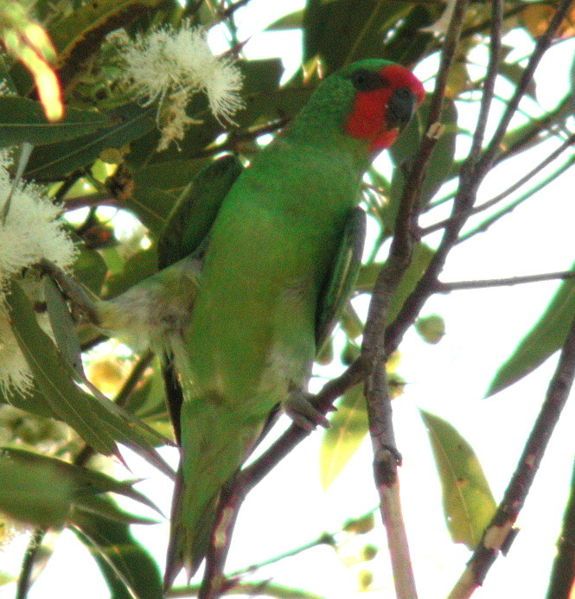
Little Lorikeet.  Glossopsitta pusilla.

(red-faced lorikeet, green parakeet) Approximately 40-45 grams and about 15 cm (6 inch) long.

Little lorikeet
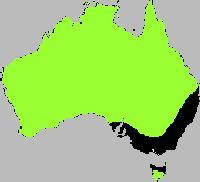
Like others in the family the little lorikeet eats mainly fruit, pollen and nectar but prefers to be high in the canopy of trees. In the wild the little lorikeet inhabits East Australian forests, coastal heath and open woodland, and is very sociable often forming large flocks.

Natural habitat of the little lorikeet
Not kept as a pet in its native Australia and a very rare pet in Europe and America.


Video of little lorikeet.


Rainbow Lorikeet.  Trichoglossus haematodus Malaccans.

Rainbow lorikeets
(blue mountain lorikeet, green collar lorikeet, bluey, swainson’s loris) 125 grams approximately with a length of about 30 cm (12 inch).


Distribution of the rainbow lorikeet
Around flowering trees and sometimes in the company of scaly-breasted lorikeets, the rainbow lorikeet may congregate in noisy flocks of several hundred to roost and eat.

The rainbow lorikeet is very popular as a pet bird in its native Australia and also quite popular in Europe and America. A pet one can be a good source of amusement as they are always playing; a young bird can become tame quite quickly.

Rainbow lorikeet on Wikipedia.

Rainbow lorikeet video on YouTube.


Varied Lorikeet.  Psitteuteles versicolor.
 
Varied lorikeet

About 55 grams and average 19 cm (7.5 inch) long.
In the wild the varied lorikeet is mainly found in large flocks in melaleuca and eucalyptus woodlands in the tropical lowlands of Australia.

Varied lorikeet distribution
Virtually unknown as a pet in America and Europe and although there are a few kept as pets in Australia, this is still a rare occurence.

Wikipedia about the varied lorikeet.


Scaly-breasted Lorikeet.  Trichoglossus chlorolepidotus.

Scaly-breasted lorikeet
(green and gold lorikeet, greenie) About 75-80 grams and about 23 cm (9.5 inch) in length.

Although common in urban areas where it makes use of nectar rich garden plants, in its natural habitat the scaly-breasted lorikeet will form large flocks, often in the company of rainbow lorikeets. These flocks will travel from tree to tree in the open forested areas of its native land.

Distribution area of scaly-breasted lorikeet
A quiet pet bird which is also playful and affectionate and can be taught to talk really well. This makes it a popular species of pet bird in Europe, America and its native Australia.


Scaly-breasted lorikeet video.


Red-collared Lorikeet.  Trichoglossus haematodus rubritorquis.

Red-collared lorikeet

Approximately 125 grams in weight with a length of about 30 cm (12 inch).
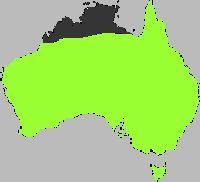
Distribution of red-collared lorikeet

Unlike most of the other species of lorikeet the red-collared lorikeet prefers to abide as a pair or in a small flock. These move around often due to their food source, the eucalyptus flower being a favourite food so they tend to inhabit the open eucalyptus forests most of the time.

Although good pet birds they are kept in low numbers because of availability and price.

Wikipedia about red-collared lorikeet.

Video of red-collared lorikeet on YouTube.


Purple-crowned Lorikeet.  Glossopsitta porphyrocephala.

Purple-crowned lorikeet
 (blue-crowned lorikeet, purple-capped parakeet) About 45 grams and around 16 cm (6 inch) long.

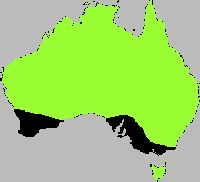
Will form large flocks where food source is plentiful, including urban gardens and orchards. Their natural habitat in the West is in forest areas, whereas in the East they tend to go for coastal heath, mallee and open woodland areas.

Natural distribution of the purple-crowned lorikeet
 Not very often kept as pets or companion birds anywhere, but a little more popular as aviary birds.

Purple-crowned lorikeet on Wikipedia.

YouTube video starring the purple-crowned lorikeet.


Accommodation and feeding

A large aviary is not required to keep lorikeets but you really should have a suspended mesh floor on your lorikeet aviary.  This is because the nature of the lorikeet diet produces lots of droppings that are difficult to clean from a solid floor (plus you will be constantly cleaning).   It is much easier and efficient to have a suspended mesh floor so you can then just hose it down to clean.  For the larger lorikeets such as the musk, rainbow, or scaly-breasted an aviary about 8 foot (2.4 metres) long, by 2 foot (0.6 metres), by 3 foot (0.9 metres) is fine.  For the smaller lorikeet species like the purple-crowned for example, an aviary of about 4 foot (1,2 metres), by 2 foot (0.6 metres), by 3 foot (0.9 metres) will be sufficient.  Don’t forget the suspended mesh floor!

Remember that unlike most parrots, lorikeets by nature live mainly on a pollen, nectar and fruit diet so you must give these types of foods to keep them at their best.  The larger species will eat seed but this should by no means be their main diet and should only be given as an extra on occasion.  Of course fresh clean water should always be available to them for bathing as well as drinking and should go without saying.  There are commercially available mixes and recipes for your lorikeets but you may need to shop around a little.  Both dry mixes and wet mixes should be provided every day along with fruit such as apple, pear, grapes, melon, paw paw, mango, oranges and tangerines for example.

Here are a couple of recipes suitable for lorikeets:

Dry recipe.  1 dessert-spoon pollen (optional), 1 cup of glucose powder, 2 cups of rice flour, 2 cups of baby rice cereal, 2 cups of egg & biscuit mix, 1 teaspoon vitamin mineral powder.  Mix all the ingredients together and store in an airtight container in the refrigerator.

Wet nectar recipe.  0.1 litre of powdered skimmed milk, a half teaspoon of calcium carbonate, 1 tablespoon of honey, 1 litre of fresh water, a half teaspoon of multi-vitamins, 0.5 litres of high protein baby cereal, 1 tablespoon of pollen.  Mix all the ingredients together (the resulting mix should be very watery), freeze the mix in ice cube trays.  Serve 1 melted ice cube (1 dessert-spoon) per bird per day.

Of course if you can get hold of some nectar bearing fresh flowers your lorikeets will love them!

For more about lorikeets click on any of these three links: 
http://www.sandiegozoo.org/animalbytes/t-lorikeet.html 
http://www.aquaticcommunity.com/lories/ 
http://en.wikipedia.org/wiki/Lories_and_lorikeets

Take a look at the lory and lorikeet pictures on the 'Stanton Birdman' 'Facebook' page

Pick up your copy of my pet bird keeping ebook on ‘Amazon Kindle’ by clicking here.

If you prefer the ebook as a ‘pdf’ on CD-rom to use on any PC (including ‘mac’) then click here.  If buying the ‘pdf’ on CD-rom I’ll throw in a free bonus as a special thank you, once your order has been confirmed I’ll email it straight out to you so no waiting for the postal service.

Loads of thanks for your interest!


As Featured On EzineArticles